• NASA
  • IPAC

Summer Visit - 2025 - HIPS-AGaiN

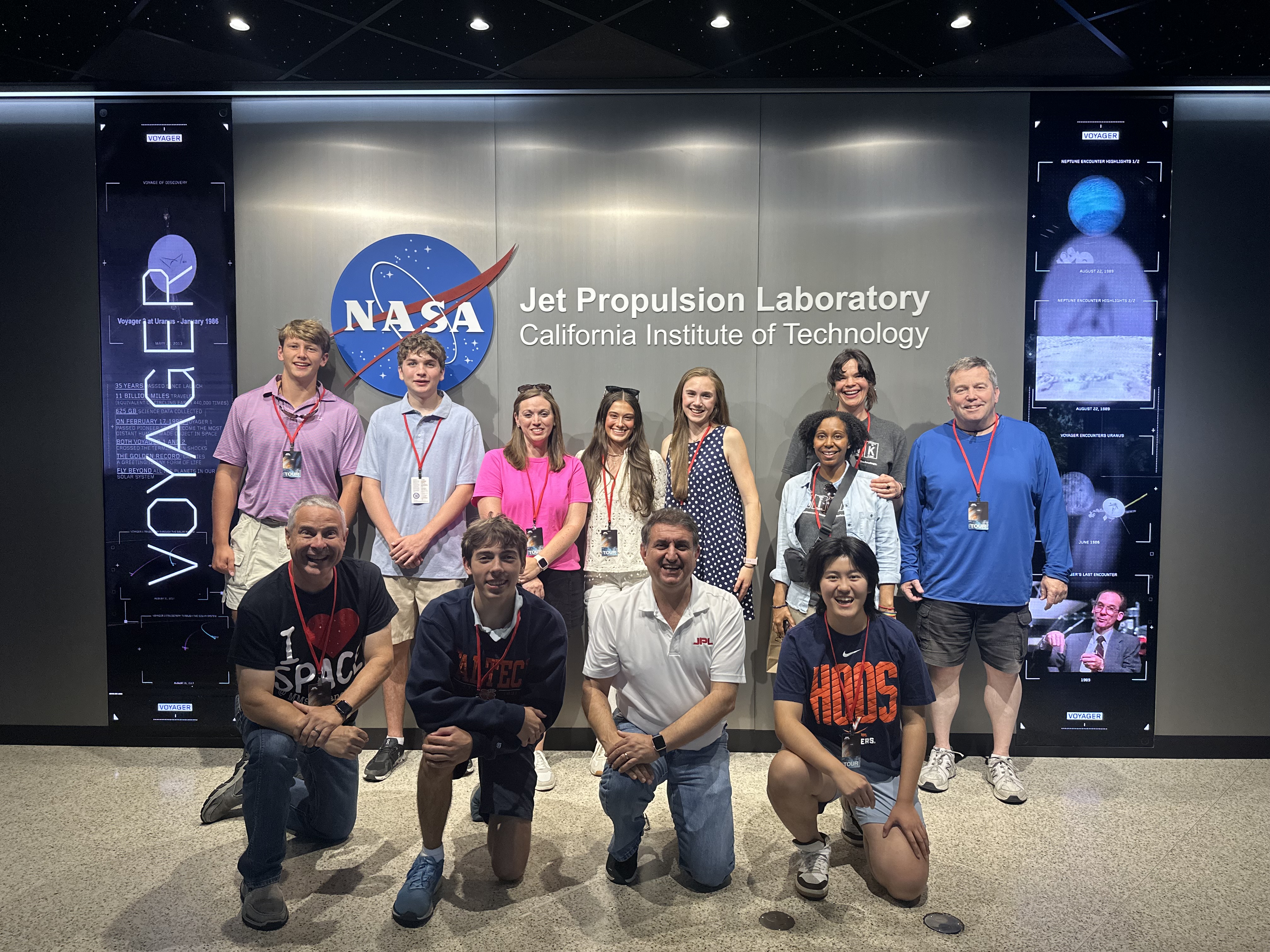
The summer visit to Caltech is 4 days long and is the only time during the year of work when all the participants on the team come together in person to work intensively on the data. Generally, each educator may bring up to two students to the summer visit that are paid for by NITARP, and they may raise funds to bring two more. The teams work at Caltech; the summer visit typically includes a half-day tour of JPL, which is a favorite site for group photos. Reload to see a different set of quotes.

The HIPS-AGaiN team came to visit in July 2025. The 4 core team educators attended, plus 6 students.

Quotes

  • I feel like one of the most surprising things I learned was how much we don’t know about the universe, but also how far we can get by relying on the laws of physics. I liked learning how to talk about AGNs in a way that left room for ambiguity. For instance, how we are using the dusty torus model for reverberation mapping, but with the acknowledgement that it might not be viewing angle or attenuation by the dusty torus that is preventing us from seeing the blue bump in type 2 AGNs. I like acknowledging and navigating those unknowns—it makes me really excited!
  • Shared, in-person, experiences lead to strong groups and strong groups lead to great results. I feel connected to my group on such a higher level now.
  • [student:] NITARP is really different from our classes where we're trying to cover so much material in a short amount of time, so you can't go in depth, right? With NITARP, we're spending several days doing a deep, deep dive into really specific information.
  • [student:] Before this experience, I did not know much about astronomers, and I had a very basic understanding of astronomy. This experience showed me that there are so many incredibly detailed and niche areas to study and research in the universe, and information gathered by one group can be used for entirely different purposes. I also learned that astronomy includes a lot of unknowns, guesswork, assumptions, and more questions than answers.
  • [Qualities of an astronomer include:] Patience, curiosity, creativity and enthusiasm. Being comfortable without knowing what the results will be. Listening to what the data is telling you and not trying to force a conclusion. Having fun solving a mystery! Having fun using well proven methods in new and creative ways. Or maybe even inventing an entirely new way to do things.

Summer Visit - 2025 - HIPS-AGaiN